
TL;DR:
- European medical university rankings differ based on research output and employer reputation.
- Program language, costs, and recognition influence admission choices and career options.
- Early planning and tailored advice improve chances for competitive 2026 applications.
Selecting the right European medical university for 2026 is one of the most consequential decisions you will make as a prospective medical student. With dozens of institutions competing for international applicants, each offering different curricula, languages of instruction, tuition structures, and admission requirements, the landscape is far more complex than a single ranking list can capture. This guide breaks down the most trusted ranking systems, profiles the leading programs, and provides a clear framework for matching your academic profile to the right institution. Whether you are targeting a research-intensive program in the UK or an English-taught option in Scandinavia, the information here will help you build a focused, realistic shortlist for 2026 admission.
Table of Contents
- How to evaluate top European medical universities
- Top European medical universities for 2026 admission
- How top programs compare: Rankings, structure, and language
- Choosing your best fit: Recommendations for different student profiles
- Our perspective: What most students miss about European medical admissions
- Next steps: Secure your place at a top European medical university
- Frequently asked questions
Key Takeaways
| Point | Details |
|---|---|
| Ranking systems matter | QS and THE rankings use different criteria, so it's smart to check both for 2026. |
| Language of instruction | English-taught medicine programs are most common in the UK, Scandinavia, and the Netherlands. |
| Assess best fit | Choose universities based on curriculum focus, language, and admission odds, not only global rank. |
| Application deadlines | Plan ahead as key application deadlines for 2026 vary by country and university. |
| Guidance streamlines admission | Expert support can help you stand out for top European medical schools. |
How to evaluate top European medical universities
Building a credible shortlist starts with understanding how rankings are constructed and what they actually measure. Two systems dominate the conversation: the Times Higher Education (THE) rankings and the QS World University Rankings. Each uses a distinct methodology, and conflating them leads to poor decisions.
The THE methodology emphasizes research quality at 30% and teaching at 29.5%, making it particularly useful for students who prioritize academic rigor and institutional research output. Oxford holds the number one global position in the 2026 THE Clinical and Pre-clinical Health subject rankings. The QS rankings for European medicine, by contrast, weight academic reputation and employer reputation more heavily, which can favor institutions with strong clinical networks and graduate employability records.
Beyond rankings, several additional factors deserve careful attention when evaluating programs:
- Language of instruction: Is the program taught fully in English, or will you need local language proficiency?
- Research vs. clinical focus: Does the curriculum prioritize laboratory research or early patient contact?
- Tuition and living costs: Annual fees vary from under 2,000 EUR at some Italian state universities to over 40,000 USD at UK private institutions.
- Program duration: Most European programs run five to six years, but integrated and graduate-entry formats exist.
- Application deadlines: These range from October to February depending on the country and institution.
- Support for international students: Visa guidance, housing, and academic support services vary significantly.
When shortlisting, ask yourself: Does this program offer clinical rotations in my target specialty? Is the degree recognized in the country where I plan to practice? What is the attrition rate for international students?
Exploring study medicine in Europe options early in the process gives you a clearer picture of the full range of programs available, including those outside the UK that are frequently overlooked.
Pro Tip: When comparing THE and QS rankings for the same institution, check whether the gap between positions is large. A school ranked significantly higher by QS than THE likely has stronger employer networks but less research output. For international students focused on clinical practice, that distinction matters.
Top European medical universities for 2026 admission
With evaluation criteria in mind, here are the top European medical universities you should consider for 2026.
European leaders in medicine according to the QS World University Rankings by Subject 2025 are primarily UK institutions alongside Karolinska Institutet in Sweden. Oxford is also ranked number one globally in the 2026 THE Clinical and Pre-clinical Health subject rankings.
| University | Country | Global Rank (THE 2026) | Program Duration | Language |
|---|---|---|---|---|
| University of Oxford | UK | 1 | 6 years | English |
| University of Cambridge | UK | 2 | 6 years | English |
| Karolinska Institutet | Sweden | Top 10 | 5.5 years | Swedish/English |
| University College London | UK | Top 10 | 6 years | English |
| Imperial College London | UK | Top 15 | 6 years | English |
| University of Amsterdam | Netherlands | Top 50 | 6 years | Dutch/English |
| Heidelberg University | Germany | Top 50 | 6 years | German |
| University of Copenhagen | Denmark | Top 60 | 6 years | Danish/English |
Here is a quick profile of what each institution offers international applicants:
- Oxford: Requires the UCAT or BMAT (check current cycle requirements), extremely competitive, strong research integration from year one.
- Cambridge: Similar entry profile to Oxford, with a distinctive three-year preclinical phase followed by three clinical years.
- Karolinska Institutet: Offers English-taught programs at postgraduate level; undergraduate programs are primarily in Swedish.
- UCL: Strong clinical network in London, accepts international students with strong A-level or equivalent qualifications.
- Imperial College London: Known for its science-intensive curriculum and early clinical exposure.
- University of Amsterdam: Selective English-taught programs available; strong European clinical network.
- Heidelberg University: Taught in German; one of Europe's oldest and most respected medical faculties.
- University of Copenhagen: Primarily Danish-taught; limited English-track options at undergraduate level.
"The difference between a good application and a successful one often comes down to how well a student understands the specific program structure, not just the name of the institution." This insight reflects what advisors consistently observe across competitive 2026 application cycles.
For students targeting English medical programs in Europe, the UK, Sweden at postgraduate level, and the Netherlands offer the most accessible entry points. Review the latest QS subject rankings to cross-reference institutional positions before finalizing your list.
How top programs compare: Rankings, structure, and language
Once you've identified the standout schools, you'll need to compare them side by side on the details that matter.
One of the most significant structural differences across European medical programs is language. English-taught programs are rare outside the UK, Scandinavia, and the Netherlands. This is a critical constraint for international students who are not fluent in German, French, or Danish.

| University | Teaching Language | Annual Tuition (approx.) | Program Format | THE Rank (Clinical) |
|---|---|---|---|---|
| University of Oxford | English | 35,000+ USD | Integrated | 1 |
| University of Cambridge | English | 35,000+ USD | Preclinical + Clinical | 2 |
| Karolinska Institutet | Swedish (UG) / English (PG) | 15,000 USD (non-EU) | Integrated | Top 10 |
| UCL | English | 35,000+ USD | Integrated | Top 10 |
| Imperial College London | English | 35,000+ USD | Science-intensive | Top 15 |
| University of Amsterdam | Dutch/English | 10,000 EUR (non-EU) | Integrated | Top 50 |
| Heidelberg University | German | 1,500 EUR | Integrated | Top 50 |
Key observations from this comparison:
- Best for research-focused students: Oxford and Cambridge, due to their integrated research years and strong laboratory infrastructure.
- Best for clinical exposure: Imperial College London and UCL, both of which have established hospital networks in London.
- Best for budget-conscious applicants: Heidelberg (if you speak German) and the University of Amsterdam for non-EU students seeking lower tuition.
- Best English-taught outside the UK: University of Amsterdam and Karolinska Institutet at postgraduate level.
Program language also affects your post-graduation options. A degree earned in German or Danish may require additional licensing steps if you plan to practice in an English-speaking country. Factor this into your long-term career planning, not just your immediate application strategy.
Choosing your best fit: Recommendations for different student profiles
Knowing how schools differ, the next step is identifying which medical university best matches your background and ambitions.
For students who are research vs. clinical focused and want English-taught programs, the options narrow quickly outside the UK, Scandinavia, and the Netherlands. Matching your profile to the right program type is more important than chasing the highest-ranked name.
Here is a breakdown by student profile:
- Language-ready students (fluent in German, Dutch, or Danish): Heidelberg, Amsterdam, or Copenhagen offer world-class education at a fraction of UK tuition.
- Research-focused students: Oxford, Cambridge, or Karolinska at postgraduate level provide the strongest research environments.
- Budget-maximizing students: Italian state universities (via the IMAT), Eastern European programs, or Heidelberg offer low tuition without sacrificing accreditation.
- Fast-track seekers: Graduate-entry programs at UCL or Imperial compress the timeline for students who already hold a relevant bachelor's degree.
To narrow your selection for 2026 intake, follow these steps:
- Confirm your language proficiency and whether you are willing to learn a new language before enrollment.
- Identify your career target country and verify that the degree is recognized there.
- Map your academic qualifications against each institution's stated entry requirements.
- Check application opening dates now. Most open in fall 2025 for 2026 entry.
- Prepare your standardized test scores (UCAT, BMAT, or IMAT) well in advance of deadlines.
- Seek guidance for medical school selection from advisors who specialize in European admissions.
Pro Tip: Students who contact admissions offices directly in the summer before application season consistently report better outcomes. Early engagement signals genuine interest and gives you accurate, up-to-date information that published guides may not reflect.
Our perspective: What most students miss about European medical admissions
With clear recommendations in hand, you need to consider the realities that rankings won't reveal.
The most common mistake we observe is students building their entire application strategy around a single ranking list. Rankings measure institutional output and reputation. They do not measure how well a program supports international students through clinical placements, language barriers, or licensing transitions.
Mid-ranked programs in the Netherlands, Italy, and Eastern Europe frequently produce graduates who practice successfully across Europe and beyond. These programs often have stronger administrative support for international students, more predictable admission processes, and lower attrition rates. Yet they are routinely dismissed because their global rank does not carry the same prestige as Oxford or UCL.
For 2026 applicants, the strategic shift is clear. Identify programs where your profile is genuinely competitive, where the language of instruction matches your current ability, and where the clinical training aligns with your specialty interest. Seek insider advice for European medical admissions from sources that understand the full spectrum of European programs, not just the top ten.
Next steps: Secure your place at a top European medical university
Armed with knowledge and perspective, you can move forward confidently to turn your 2026 ambitions into action.
Navigating European medical admissions requires more than reading rankings. It demands precise knowledge of entry requirements, application timelines, and program fit. That is exactly where expert guidance makes a measurable difference.
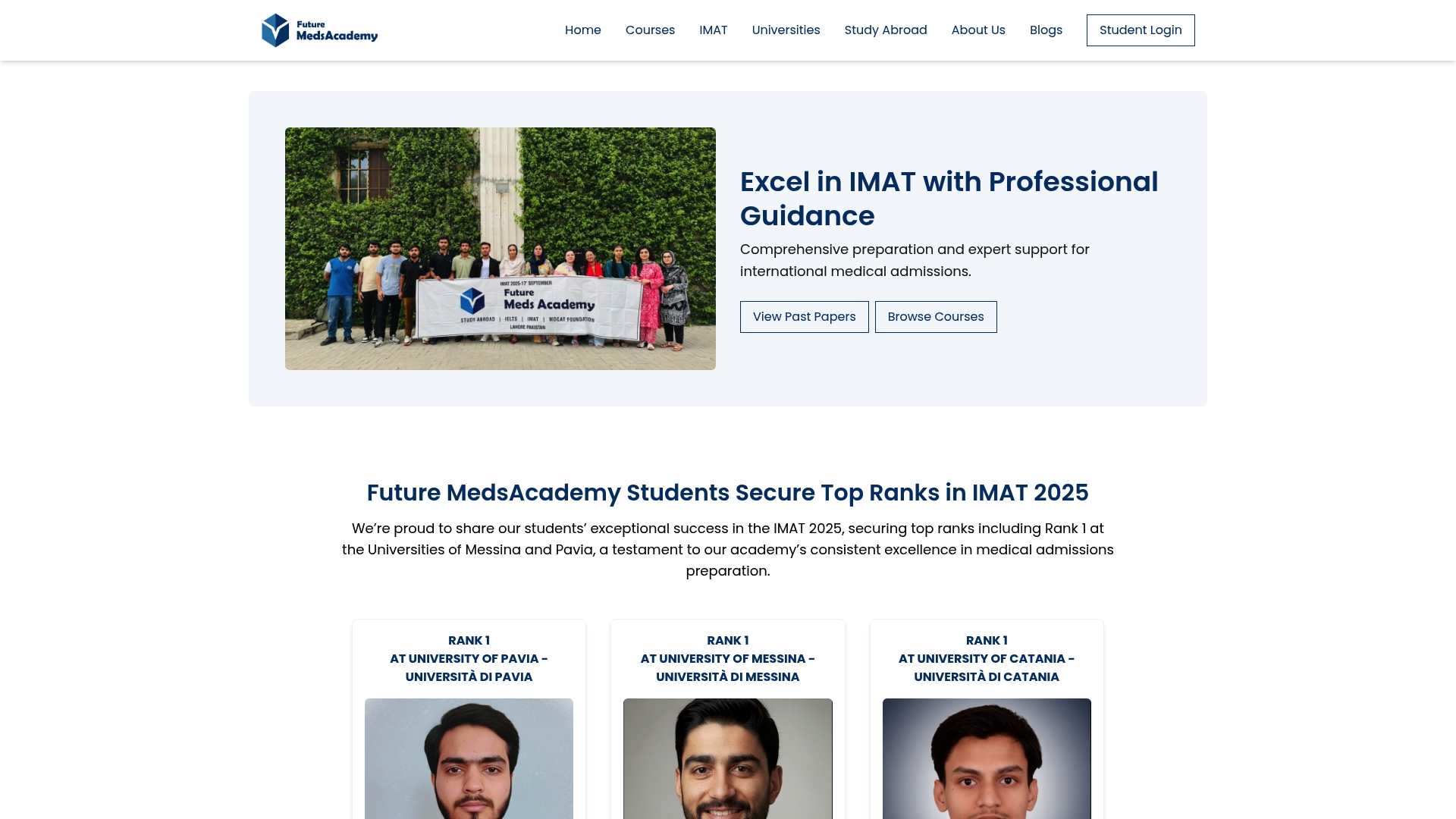
Future MedsAcademy provides structured preparation, personalized mentorship, and end-to-end application support for students targeting top European medical universities. From IMAT preparation to university selection and visa guidance, the platform covers every step of the process. Students who have worked with Future MedsAcademy have secured placements at Pavia, Messina, Catania, and other leading institutions. If you are serious about 2026 admission, this is the logical next step.
Frequently asked questions
Which European medical universities are taught in English?
The majority of fully English-taught undergraduate medical programs are in the UK, Sweden (at postgraduate level), and the Netherlands. English-taught programs are rare outside these regions at the undergraduate level.
What entry exams are required for top European medical universities?
Most leading universities require standardized tests such as the UCAT, BMAT, or IMAT, along with language proficiency evidence for non-native speakers. Specific entry criteria vary by institution and country, so verify requirements directly with each university.
How important are rankings for medical school selection?
Rankings provide a useful starting point, but program fit matters equally alongside language of instruction, teaching style, and degree recognition in your target country.
When should I apply for 2026 entry to European medical schools?
Most application cycles open in fall 2025, with key deadlines varying between October and February depending on the country and institution. Begin preparing your documents and test scores at least six months before your target deadline.