
Most students who attempt the IMAT without a deliberate strategy discover too late that casual study simply does not work. The IMAT exam overview covers five demanding subject areas, all tested in English, within a strict 100-minute window. A structured IMAT preparation plan is a systematic, goal-oriented approach that organizes your study timeline, subject priorities, and practice schedule into a coherent framework. This article breaks down what that framework looks like, why it produces measurably better outcomes, and how you can build one that fits your specific starting point and target score.
Table of Contents
- Understanding the IMAT and its challenges
- The elements of a structured IMAT preparation plan
- Benefits of following a structured plan for IMAT
- Building your own structured IMAT study schedule
- Why most IMAT prep plans fail—and the key to real results
- Accelerate your IMAT success with expert guidance
- Frequently asked questions
Key Takeaways
| Point | Details |
|---|---|
| Structure beats randomness | A structured IMAT prep plan offers better results and less stress than unplanned studying. |
| Personalization matters | Adapting your schedule to your strengths and weaknesses is crucial for success. |
| Regular review is key | Tracking and adjusting your progress ensures you stay on target for exam day. |
| Expert resources help | Leveraging quality guidance and materials saves time and boosts confidence. |
Understanding the IMAT and its challenges
The IMAT (International Medical Admissions Test) is administered annually by Cambridge Assessment Admissions Testing and is used by Italian public universities to select candidates for their English-language medicine programs. Universities such as Pavia, Messina, and Catania all rely on IMAT scores to rank applicants. The exam is highly competitive for admissions, with thousands of international applicants competing for a limited number of seats each cycle.
The exam consists of 60 questions distributed across five sections:
- General knowledge and logical reasoning (10 questions)
- Biology (23 questions)
- Chemistry (15 questions)
- Physics and mathematics (12 questions)
- Critical thinking and problem solving (embedded in the reasoning section)
Scoring follows a specific formula: +1.5 for a correct answer, 0 for no answer, and -0.4 for a wrong answer. This penalty system makes guessing a calculated risk, not a default strategy.
| Exam feature | Detail |
|---|---|
| Duration | 100 minutes |
| Total questions | 60 |
| Language | English |
| Scoring | +1.5 / 0 / -0.4 |
| Administered by | Cambridge Assessment |
Despite this structure, many candidates underestimate the preparation required. The most common mistakes include starting too late, studying subjects in isolation without integrating them, and neglecting weaker areas in favor of comfortable topics. Students who rely on passive review, such as re-reading notes without active recall or timed practice, consistently underperform relative to their actual knowledge base.
"The IMAT is a highly competitive exam for medical school admissions in Europe, and unstructured preparation is one of the primary reasons candidates fall short of their target scores."
To tackle these challenges, the first step is understanding what makes IMAT unique. Unlike national medical entrance exams, the IMAT tests reasoning and application, not just memorization. Biology questions, for example, often require you to interpret experimental data rather than recite definitions. This distinction fundamentally changes how you should prepare.
The elements of a structured IMAT preparation plan
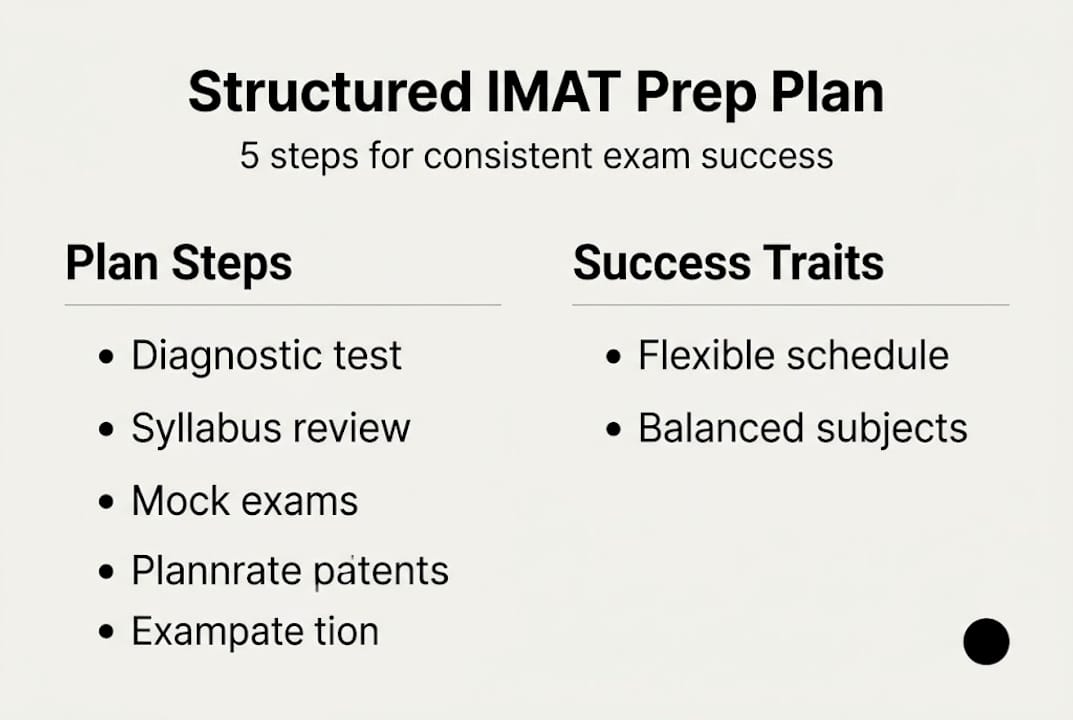
A structured plan is not simply a timetable. It is an integrated system with five core components that work together to build and reinforce competency across all tested subjects.
- Set a study timeline with milestone goals. Map out the weeks between your start date and exam day. Divide this period into phases: foundation building, subject-specific deep work, integration and mock exams, and final review. Each phase should have a measurable output.
- Organize content by subject and subtopic. Break biology, chemistry, physics, and mathematics into specific subtopics. Assign each subtopic a priority level based on its frequency in past papers and your current proficiency.
- Incorporate varied, timed practice. Passive reading builds familiarity. Active recall, timed drills, and full-length mock exams build performance. Schedule at least one full mock every two weeks during the integration phase.
- Track performance and adjust the plan. After every mock or drill session, log your scores by section. Identify patterns in your errors. Adjust your weekly focus accordingly.
- Use reputable, exam-aligned materials. Not all study resources are created equal. Prioritize materials built specifically for the IMAT syllabus rather than generic science textbooks.
| Approach | Unstructured prep | Structured prep |
|---|---|---|
| Study direction | Random topics | Syllabus-aligned priorities |
| Practice type | Passive review | Timed drills and mocks |
| Progress tracking | None | Regular performance logs |
| Adjustment | Rarely | After every session |
| Outcome | Inconsistent | Predictable improvement |
Students who follow successful IMAT prep strategies that incorporate these five components consistently demonstrate higher section scores compared to those who study without a defined system. Structured plans score higher on standardized exams because they eliminate the guesswork from daily study decisions.
Pro Tip: Reserve the first week of your preparation exclusively for diagnostic practice. Complete a timed past paper under exam conditions before you study anything. Your raw score will reveal exactly where to focus first.
Benefits of following a structured plan for IMAT
Understanding these benefits can motivate you to adopt a structured approach from day one rather than waiting until pressure forces you to organize.
The most direct benefit is a higher test score. Organized prep leads to higher admission rates because structured candidates cover the full syllabus systematically, leaving fewer knowledge gaps on exam day. They also develop exam-specific skills, such as time management under pressure and penalty-aware answer selection, that unstructured studiers rarely practice deliberately.

A second, often overlooked benefit is reduced cognitive fatigue and burnout. When you do not have a plan, every study session begins with a decision: what to study, for how long, and using which materials. That decision fatigue compounds over months and erodes motivation. A structured schedule eliminates those micro-decisions, freeing mental energy for actual learning.
Structured preparation also builds measurable confidence. When you can look at a performance log and see your biology score improving from 8 to 14 over six weeks, that data provides objective reassurance. Confidence grounded in evidence is far more durable than optimism based on hope.
- Higher section scores through systematic coverage of all tested subtopics
- Lower stress levels from knowing exactly what to study each day
- Better time management on exam day through repeated timed practice
- Stronger retention from spaced repetition and active recall techniques
- Improved weak areas through targeted, data-driven adjustment
Past candidates who secured placements at top Italian universities consistently report that their preparation was defined by consistency and iteration, not intensity alone. Reviewing IMAT prep insights from high scorers reveals a clear pattern: those who tracked and adjusted outperformed those who simply studied harder.
Pro Tip: Do not wait until you feel ready to take a mock exam. Take one early, even if your score is low. Early diagnostic data is the most valuable information you will collect during your entire preparation.
Building your own structured IMAT study schedule
Now that you know the benefits, it is time to put a plan into action. Building a personalized schedule requires four sequential steps.
- Assess your baseline. Complete a timed past paper. Score it by section. Note which areas fall below 50% accuracy. These are your highest-priority subjects.
- Select your resources. Choose one primary resource per subject. Avoid the trap of collecting multiple textbooks without finishing any. Supplement with official past papers and IMAT-specific question banks.
- Build a weekly calendar. Allocate study blocks by subject weight and personal weakness. A candidate weak in chemistry should assign more weekly hours to chemistry than to a subject already near mastery.
- Schedule weekly reviews. Every Sunday, review your performance log from the previous week. Identify one adjustment to make in the coming week. This could be shifting time from a stronger subject to a weaker one, or replacing passive review with active recall drills.
Personalized IMAT study plans that incorporate diagnostic data from the outset produce faster improvement than generic schedules because they align effort with actual need. IMAT preparation resources often provide sample study schedules for personalization, which you can use as a starting framework and then modify based on your own baseline results.
Additional practices that support schedule adherence include:
- Joining online IMAT study communities for accountability and resource sharing
- Using spaced repetition software for high-volume content areas like biology
- Blocking specific times for rest and recovery to prevent burnout
- Logging daily study hours to identify patterns in productivity
Flexibility is not a weakness in a structured plan. It is a design feature. The schedule should serve your performance, not the other way around.
Why most IMAT prep plans fail—and the key to real results
The most common reason structured plans fail is not lack of effort. It is rigidity. Many candidates download a generic 6-month schedule, follow it for three weeks, fall behind by one day, and then abandon the entire framework. That all-or-nothing response to minor disruptions is what separates candidates who plateau from those who keep improving.
Top-scoring IMAT candidates share one consistent trait: they treat their study plan as a living document. They review it weekly, revise it based on performance data, and prioritize self-assessment over schedule compliance. The plan is a tool, not a contract.
Another critical insight from high performers is that subject balance matters more than total hours. A candidate who spends 80% of their time on biology while neglecting physics will hit a ceiling. The IMAT's scoring formula means that consistent performance across all sections outperforms excellence in one area combined with weakness in another.
Exploring insider IMAT strategies from candidates who have scored in the top percentile consistently reveals this same principle: adaptability within structure is what drives real results. Build the plan, follow it, and revise it often.
Accelerate your IMAT success with expert guidance
Building a structured plan from scratch is achievable, but expert guidance compresses the learning curve significantly. Future MedsAcademy provides candidates with ready-built, evidence-informed preparation frameworks that eliminate the guesswork from scheduling, resource selection, and performance tracking.

Future MedsAcademy offers structured courses, full-length mock exams, interactive lessons, and personalized mentorship designed specifically for the IMAT syllabus. The platform also supports students with university selection, visa applications, and scholarship guidance, covering every stage of the admissions process. If you are ready to move from planning to results, explore the available courses and start your structured preparation today.
Frequently asked questions
How long should I prepare for the IMAT using a structured plan?
Most experts recommend at least 3 to 6 months of consistent, structured study for the IMAT, with longer timelines recommended for candidates who need to build foundational science knowledge from the ground up.
Can I rely on online resources to build my IMAT study plan?
Online platforms offer structured courses, past papers, question banks, and community support that are well-suited for building and executing a complete IMAT preparation plan.
What should I do if I fall behind on my IMAT study schedule?
Reassess your plan immediately, identify the specific subjects or time blocks causing the gap, and adjust your schedule to redistribute effort without abandoning the overall structure.
Is a structured plan necessary for IMAT success?
A structured plan is not just helpful; it is the most reliable method for maximizing IMAT outcomes because it ensures full syllabus coverage, consistent practice, and data-driven adjustment throughout your preparation.