
The IMAT application process is one of the most detail-intensive workflows a prospective medical student will face. Between gathering documents, meeting university-specific deadlines, registering for the exam, and tracking submission status, the margin for error is narrow. Many applicants underestimate how much coordination is required before they even sit the test. This guide breaks the entire process into clear, sequential stages, from understanding the exam’s role in admissions to verifying your final submission, so you can move through each step with precision and confidence.
Table of Contents
Key Takeaways
| Point | Details |
|---|---|
| IMAT is essential | Your IMAT score determines your eligibility for medical programs in Italy. |
| Organize documents early | Gather all required paperwork and credentials well ahead of submission deadlines. |
| Follow each step | Complicated application workflows are easier when broken down into clear, sequential actions. |
| Check and verify | Always review your status and confirm submission to avoid errors or missed opportunities. |
| Get support if needed | Expert guidance can save time and boost your chances of successful IMAT application. |
Understanding the IMAT and its importance
The IMAT, or International Medical Admissions Test, is a standardized exam used by Italian public universities and select European institutions to evaluate candidates applying to English-taught medical and surgery degree programs. Administered by the Italian Ministry since 2023, it covers four core subject areas: logical reasoning and general knowledge, biology, chemistry, and physics and mathematics. Each section carries a specific weighting, and your total score determines your position on the national ranking list.
Understanding why the IMAT matters goes beyond knowing what it tests. Universities use IMAT scores as the primary filter in their selection process. A higher score directly increases your probability of placement at a competitive institution. The ranking system is merit-based and transparent, meaning every point counts.
Here is a summary of what the IMAT evaluates:
-
Logical reasoning and general knowledge: Tests critical thinking and broad academic awareness
-
Biology: Covers cell biology, genetics, anatomy, physiology, and ecology
-
Chemistry: Focuses on organic and inorganic chemistry, stoichiometry, and chemical bonding
-
Physics and mathematics: Includes mechanics, thermodynamics, algebra, and statistics
The exam consists of 60 multiple-choice questions answered in 100 minutes, with a scoring system that awards 1.5 points for correct answers, deducts 0.4 points for incorrect ones, and assigns 0 for unanswered questions. This scoring model rewards accuracy over guessing.
Statistic callout: In recent years, thousands of international students have competed for a limited number of seats at Italian medical universities, making IMAT preparation and a strong score more critical than ever.
For students researching their options, reviewing IMAT degree options across Italian and European universities is an essential early step. Different universities offer varying seat allocations for EU and non-EU students, which directly affects your strategic approach to applications.
Gathering prerequisites and understanding requirements
Before you register for the IMAT or submit any university application, you need to confirm that you meet all eligibility criteria and have the correct documentation prepared. This stage is where many applicants lose time due to incomplete or incorrectly formatted materials.
Most Italian public universities require the following documents for IMAT applicants:
-
Secondary school diploma or equivalent: Must be officially recognized or equivalent to the Italian maturità (You must complete 12 years of education)
-
Official academic transcripts: Translated into Italian or English, depending on the institution
-
Valid passport or national ID: For identification during registration and exam day
-
English language proficiency certificate: Such as IELTS or TOEFL, though requirements vary by university
-
Passport-sized photographs: Conforming to specific dimensions and format requirements
-
Declaration of value (Dichiarazione di Valore) or CIMEA: Required for non-EU applicants to verify foreign qualifications
Eligibility requirements differ between institutions. Some universities have specific GPA thresholds or require pre-enrollment through the Italian Ministry of Foreign Affairs (Ministero degli Affari Esteri). Non-EU applicants often face additional steps, including obtaining a student visa and completing pre-enrollment at an Italian consulate.
| Requirement | EU Applicants | Non-EU Applicants |
|---|---|---|
| Pre-enrollment via consulate/ UniversItaly | Not required | Required |
| Declaration of value | Not required | Required |
| Student visa | Not required | Required |
| Language certificate | Varies | Varies |
| Translated transcripts | Recommended | Required |
Pro Tip: Start collecting and certifying your documents at least three months before the application window opens. Translation and notarization services can take weeks, and delays in this stage cascade into every subsequent step.

Verify each university’s specific requirements directly through their admissions office or official website, as requirements can shift between cycles. Do not assume that what applied in 2025 remains unchanged for 2026.
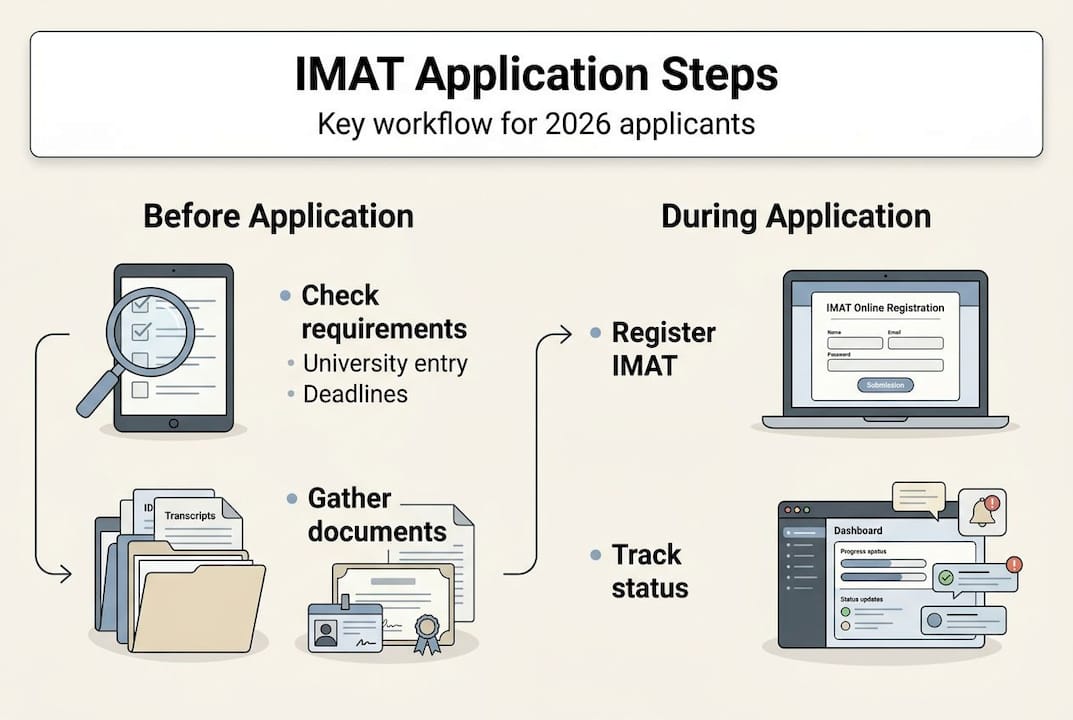
Step-by-step application submission process
Once your documents are in order, the application submission process follows a structured sequence. Missing any single step or submitting materials out of order can result in disqualification or delays.
-
Register on the official IMAT platform: Visit the Universitaly and create your candidate account. This is separate from any university-specific registration.
-
Complete university pre-enrollment (non-EU applicants): Submit your pre-enrollment application through the Italian consulate in your home country. This step must be completed before the IMAT registration deadline.
-
Register for the IMAT exam: Once pre-enrollment is confirmed (if applicable), complete your IMAT registration through the official portal, selecting your preferred test center.
-
Pay the registration fee: The IMAT registration fee must be paid online during the registration window. Keep your payment confirmation as proof.
-
Complete the university’s online application form: Each university has its own application portal. Fill out all required fields accurately, including personal details, academic history, and document uploads.
-
Upload all required documents: Ensure files meet the specified format and size requirements. Common formats are PDF and JPEG. Incorrectly formatted files are a leading cause of rejected submissions.
-
Submit and confirm: After uploading, review all entries before final submission. Most portals generate a confirmation number or email upon successful submission.
Pro Tip: Use a dedicated folder (digital and physical) for each university you apply to. Label every document with the university name and document type to avoid uploading the wrong file to the wrong portal.
| Step | Action required | Common mistake |
|---|---|---|
| IMAT registration | Create account, select test center | Missing the registration deadline |
| Document upload | PDF/JPEG, correct dimensions | Wrong file format or oversized files |
| Fee payment | Online payment, save confirmation | Not saving proof of payment |
| University form | Accurate personal and academic data | Typos in name or ID number |
Double-check that your name appears identically across all documents and forms. A mismatch between your passport name and your application form is one of the most common and easily avoidable errors.
Troubleshooting, tracking, and final verification
Submitting your application is not the final step. After submission, active monitoring and verification are necessary to ensure everything is processed correctly.
Here is what to monitor after submission:
-
Application portal status: Log in regularly to check whether your status has moved from “submitted” to “under review” or “confirmed.”
-
Email notifications: Universities send status updates and requests for additional documents via email. Check your inbox and spam folder daily during the review period.
-
Document verification requests: If a document is flagged as incomplete or unreadable, the university will typically notify you and provide a correction window.
-
IMAT admit card: Once your registration is confirmed, download and save your admit card. This is required for entry on exam day.
“Applicants who proactively follow up with admissions offices after submission report fewer issues on exam day and during enrollment, compared to those who assume no news is good news.”
If you identify an error after submission, contact the university’s international admissions office immediately. Most institutions allow corrections within a defined window, but this window is short. Document every communication, including the date, the name of the contact, and the content of the exchange.
Pro Tip: Create a tracking spreadsheet listing each university, submission date, confirmation number, current status, and next action required. This prevents critical follow-up tasks from falling through the gaps.
Before test day, confirm the following:
-
Your admit card is downloaded and printed
-
Your test center location and reporting time are confirmed
-
Your identification document matches the one registered in your application
-
You have reviewed the exam rules regarding permitted materials
What most IMAT applicants miss—and how to stand out
Most applicants follow the instructions. Fewer applicants follow up. The difference between a smooth admissions experience and a stressful one often comes down to proactive communication. Contacting a university’s admissions office before the deadline to confirm receipt of your documents is not overstepping. It is due diligence.
Another pattern we observe consistently is that applicants who begin the process early, not just document collection but also score benchmarking and university shortlisting, make better strategic decisions. They apply to institutions where their projected score is competitive, rather than applying broadly without a clear ranking strategy.
The overlooked step is score simulation. Before the exam, use past papers and mock tests to estimate your likely score range. Then map that range against the historical cutoff scores of your target universities. This gives you a data-driven basis for your application list, not just hope. Preparation and strategy are inseparable in this process. Applicants who treat them as separate activities consistently underperform those who integrate both from the start.
Resources to streamline your IMAT application
Navigating the IMAT application workflow is significantly more manageable with structured support. Future Meds Academy provides expert guidance specifically designed for students working through each stage of the process, from document preparation to score optimization.
Whether you need help reviewing your application materials, understanding university-specific requirements, or accessing mock tests and structured study plans, Future Meds Academy offers targeted resources for 2026 applicants. The platform also supports students with administrative questions, university selection strategy, and visa guidance. Access IMAT resources and connect with advisors who have guided students into top-ranked programs at universities including Pavia, Messina, and Catania. The right support at the right stage makes a measurable difference in outcomes.
Frequently Asked Questions (IMAT 2026)
1. What is the deadline for IMAT 2026 applications?
The IMAT application process involves multiple steps with different timelines.
-
Pre-enrolment on Universitaly typically opens between April and July (exact dates vary each year).
-
Individual universities may set their own internal deadlines for document submission, usually within this same period.
-
The IMAT registration (through MINERVA) usually takes place in September 2026.
It is important to regularly check both the Universitaly portal and your chosen university website for exact dates.
2. Can I apply to multiple European medical universities with one IMAT application?
-
Non-EU students: You can apply to only one Italian public university for Medicine via IMAT.
-
EU students: You can compete for multiple universities through the national ranking system and indicate preferences.
Your single IMAT score is used across the centralized ranking, but your eligibility depends on your application category (EU vs Non-EU).
3. What documents are most commonly required for IMAT applications?
While requirements may vary slightly by university, the most commonly required documents include:
-
High school diploma or equivalent qualification
-
Official academic transcripts
-
Valid passport or national ID
-
English language certificate (such as IELTS or TOEFL, if applicable)
-
Declaration of Value (DoV) or CIMEA Statement of Comparability (for non-Italian qualifications)
Always verify specific requirements on the university’s official website.
4. How do I check if my IMAT application was successfully submitted?
You should:
-
Log in to the Universitaly portal and your chosen university’s application portal
-
Check for a confirmation email or application receipt
-
Look for status updates such as “submitted,” “received,” or “under evaluation” in ranking list in case of NON-EU students
If no confirmation is received, it is advisable to contact the university admissions office directly.
5. Where can I find guidance for preparing my IMAT application?
You can prepare independently using official guidelines and university instructions. However, many students choose structured support platforms such as Future Meds Academy, which provide:
-
Step-by-step application guidance
-
Document preparation support
-
Strategic university selection
-
IMAT preparation resourcesRecommended