
TL;DR:
- European pre-med programs prepare students for IMAT and medical school admission in a short, targeted format.
- These programs focus on science, reasoning, and English skills aligned with IMAT content.
- Active engagement and strategic preparation during pre-med are essential for successful medical school entry.
For many aspiring medical students, the path to a European medical university begins with a critical question: do you need a pre-med program, and how does it fit with IMAT preparation? The answer depends on your academic background, science proficiency, and English language skills. European pre-med programs in Europe are specifically structured to bridge the gap between secondary education and the rigorous demands of medical school admissions. This guide breaks down exactly what these programs involve, who benefits most from them, and how to use one strategically to maximize your IMAT performance and medical school application.
Table of Contents
- What is a pre-med program in Europe?
- Who should consider a European pre-med program?
- How do European pre-med programs prepare you for the IMAT?
- Finding and choosing the right pre-med program in Europe
- After completing your European pre-med: next steps to medical school
- Europe's pre-med pathway: what most students misunderstand
- Next steps: start your European medical journey with expert support
- Frequently asked questions
Key Takeaways
| Point | Details |
|---|---|
| Pre-med structure | European pre-med programs cover sciences, English, and IMAT-specific skills. |
| Ideal candidates | International students and those with gaps in science or English benefit most. |
| IMAT alignment | Top programs align closely with IMAT requirements for better preparation. |
| Application process | Pre-med is just one step—IMAT and careful university application are also essential. |
What is a pre-med program in Europe?
A European pre-med program is a structured academic course designed to prepare international students for medical school entry, with a specific focus on the IMAT and equivalent admissions processes. Unlike the US pre-med model, which spans four undergraduate years, European pre-med programs are typically condensed and highly targeted. They are not degree programs. They are preparatory tracks built to fill knowledge gaps and sharpen exam readiness in a relatively short period.
According to Future Meds Academy, pre-med programs in Europe focus on foundational sciences, English, and admissions test prep. The curriculum typically covers biology, chemistry, physics, mathematics, logical reasoning, and academic English. Programs range from intensive short courses lasting a few weeks to full academic year formats that run nine to twelve months. Delivery formats vary widely: some programs are fully online, others are in-person in cities across Italy, the UK, or Eastern Europe, and many offer hybrid models.
Skills gained through a European pre-med program include:
- Foundational biology and chemistry knowledge aligned with IMAT specifications
- Logical reasoning and critical thinking skills
- Academic English proficiency for lectures and written assessments
- Familiarity with European medical school culture and expectations
- Test-taking strategy and time management under exam conditions
Common components of European pre-med programs:
| Subject | Hours/Weeks | Assessment method | IMAT relevance |
|---|---|---|---|
| Biology | 60 to 80 hours | Written exams, MCQs | High |
| Chemistry | 50 to 70 hours | Problem sets, MCQs | High |
| Physics and math | 30 to 50 hours | Problem sets | Moderate |
| Logical reasoning | 20 to 40 hours | Practice tests | High |
| Academic English | 20 to 30 hours | Essays, oral assessments | Moderate |
The key distinction from a US pre-med pathway is focus. European programs are not about accumulating credits over years. They are about precision preparation for a specific admissions outcome.
Who should consider a European pre-med program?
Not every student needs a pre-med year. But for many international applicants, it is the most efficient route to IMAT readiness. International student admissions data consistently shows that students from non-EU educational systems benefit most from structured IMAT preparation offered in European pre-med tracks.
Steps to determine if you need a pre-med program:
- Review your eligibility. Confirm that your secondary school diploma meets the minimum requirements for Italian or European medical university entry.
- Check your science background. Assess whether your biology, chemistry, and physics knowledge aligns with the IMAT syllabus. Gaps are common among students from systems that de-emphasize lab sciences.
- Evaluate your IMAT readiness. Take a diagnostic practice test. If your score falls significantly below competitive thresholds, structured preparation is essential.
- Assess your English language skills. The IMAT is conducted in English. If English is not your first language and you have not studied in an English-medium school, targeted language preparation is critical.
Students who benefit most include recent high school graduates from Asia, Africa, and the Americas whose curricula did not cover IMAT content in depth. Career changers moving from non-science fields also find pre-med programs invaluable for building foundational knowledge from scratch. Students who have already completed some university science coursework may only need a shorter intensive program rather than a full academic year.

Pro Tip: Some European universities allow direct entry without a pre-med program if your academic background is strong. Always verify entry requirements with your target institution before investing time and tuition in a preparatory course.
How do European pre-med programs prepare you for the IMAT?
The IMAT is a 100-minute multiple choice exam covering biology, chemistry, physics, mathematics, logical reasoning, and general knowledge. It is administered by the Italian Ministry of University and Research and used by Italian state universities to select international students for English-medium medical programs. IMAT-focused courses within European pre-med programs align their syllabi directly with IMAT exam requirements, ensuring that study time is never wasted on irrelevant content.
Pre-med content vs. IMAT syllabus domain coverage:
| Subject | Hours in pre-med | IMAT weighting | Test format |
|---|---|---|---|
| Biology | 60 to 80 hours | ~40% of science questions | MCQ, 4 options |
| Chemistry | 50 to 70 hours | ~30% of science questions | MCQ, 4 options |
| Physics and math | 30 to 50 hours | ~15% of science questions | MCQ, 4 options |
| Logical reasoning | 20 to 40 hours | ~25% of total score | MCQ, deductive |
| General knowledge/English | 20 to 30 hours | ~10% of total score | MCQ |
One area many students underestimate is the logical reasoning section. It tests skills that are rarely covered in standard secondary school curricula, including deductive reasoning, data interpretation, and argument analysis. Strong pre-med programs dedicate specific modules to this section, using timed practice tests and worked examples to build fluency.
Study methodologies in quality programs include weekly mock exams, spaced repetition for science content, interactive problem-solving sessions, and individualized feedback on weak areas. The combination of structured content delivery and consistent exam simulation is what separates effective pre-med preparation from self-study alone.
Note: Even students with strong science backgrounds frequently struggle with the IMAT's logical reasoning and time pressure. Pre-med programs that simulate real exam conditions are not optional extras. They are core preparation tools.
Finding and choosing the right pre-med program in Europe
With a growing number of providers offering pre-med tracks, selecting the right program requires a clear evaluation framework. Choosing a European pre-med course that is genuinely IMAT-aligned, taught in English, and supported by transparent outcomes data is non-negotiable. Leading programs offer transparent admission criteria and success stories of previous IMAT passers, which gives prospective students a realistic benchmark for what to expect.
Questions to ask before enrolling:
- Is the program accredited or recognized by a reputable institution?
- What percentage of graduates pass the IMAT and gain medical school placement?
- Are teaching staff experienced in IMAT content and international student support?
- What is the cohort size, and how much individualized attention will you receive?
- What is included in the tuition: materials, mock tests, application support?
- Are there alumni you can speak with directly about their experience?
Red flags to watch for include vague program descriptions with no clear syllabus, providers that cannot share IMAT pass rate data, and courses that lack any logical reasoning or English language component. An unaccredited provider with no verifiable track record is a significant financial and academic risk.
Pro Tip: Request a conversation with a current student or recent graduate before committing. No marketing material tells you more than a five-minute conversation with someone who has been through the program.
After completing your European pre-med: next steps to medical school
Completing a pre-med program is a significant achievement, but it is not the finish line. Pre-med completion alone does not guarantee medical university admission. IMAT performance and the formal application process remain essential steps that require careful planning.
Typical timeline after finishing a European pre-med program:
- Register for the IMAT. Registration typically opens in June or July for the September exam. Confirm exact dates with the Italian Ministry of University and Research each year.
- Submit university applications. Apply to your chosen Italian state universities through the official Universitaly portal, providing all required documents.
- Prepare supporting documents. This includes your secondary school diploma, certified translations, passport copies, and English language certification if required.
- Sit the IMAT exam. The exam is held once per year, typically in September. Your score determines your ranking across all applied universities.
- Attend interviews if required. Some universities may require additional assessments or orientation sessions before final enrollment.
- Finalize enrollment and visa. Non-EU students must apply for a student visa through their local Italian consulate. Processing times vary by country, so begin this process early.
International students should also factor in language certification requirements. While the medical programs are English-medium, some universities require proof of English proficiency such as an IELTS score. Preparing for both the IMAT and language certification simultaneously is manageable with proper planning.
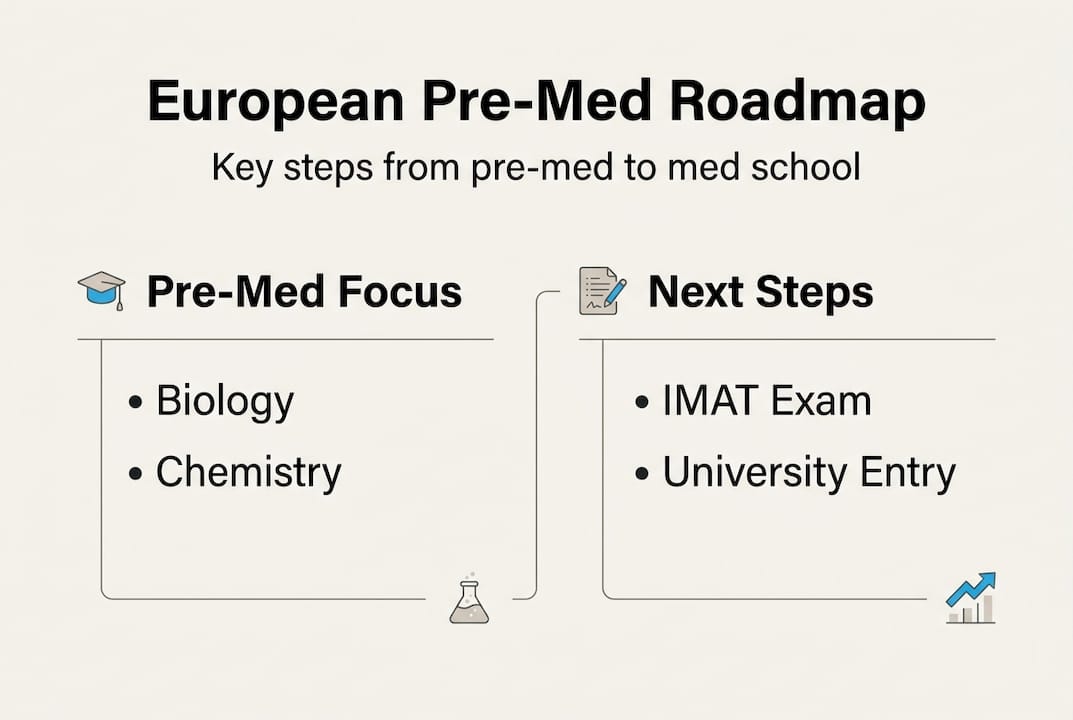
Europe's pre-med pathway: what most students misunderstand
The most common misconception about European pre-med programs is that completing one is sufficient for medical school entry. It is not. A pre-med program provides the knowledge foundation and exam strategy, but the IMAT still demands consistent personal effort, disciplined study habits, and a clear test-taking approach. Students who treat the pre-med year as a passive experience, attending classes without active engagement or self-directed practice, rarely achieve competitive IMAT scores.
Another overlooked element is the logical reasoning and English preparation component. Many students from strong science backgrounds assume these sections will be straightforward. In practice, the logical reasoning section is where well-prepared science students lose critical ranking points. Programs that integrate reasoning skills throughout the curriculum, rather than treating them as an afterthought, produce measurably better outcomes.
Finally, the social and professional network built during a European pre-med program is an underutilized resource. Cohorts are typically international, bringing together students from dozens of countries. These connections become study partners, referral sources, and long-term professional contacts throughout your medical career. For more on maximizing your preparation strategy, academy insights from Future Meds Academy provide detailed guidance on both academic and administrative aspects of the journey.
Pro Tip: Treat your pre-med year as an active investment, not a formality. The students who engage most deeply with their cohort, instructors, and practice materials consistently outperform those who approach it as a box-ticking exercise.
Next steps: start your European medical journey with expert support
Navigating pre-med programs, IMAT preparation, and university applications simultaneously is a complex process. The right guidance makes the difference between a well-executed plan and costly missteps.
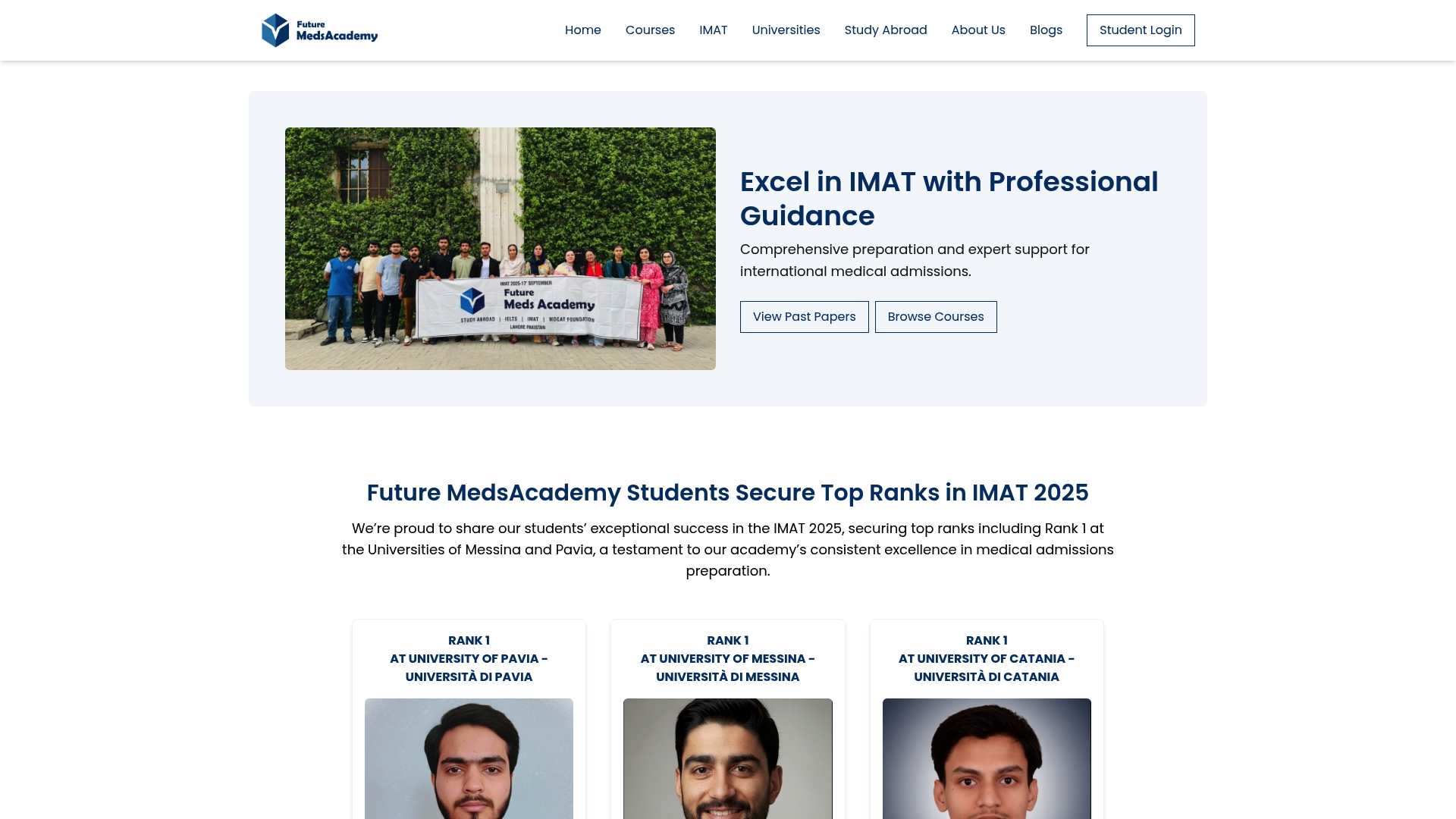
The Future MedsAcademy platform offers structured IMAT preparation courses, personalized mentorship, mock exams, and full administrative support covering university selection, visa guidance, and scholarship identification. Students who have prepared through Future Meds Academy have secured placements at top Italian universities including Pavia, Messina, and Catania. Whether you are selecting a pre-med program, preparing for the IMAT, or managing your application, expert support is available at every stage of your journey.
Frequently asked questions
Do I need a pre-med program in Europe if I already have a science background?
If your prior education covered IMAT topics in depth and your English proficiency is strong, direct entry is possible for some students, but IMAT readiness is the deciding factor. Always verify with your target universities before skipping preparatory coursework.
Are European pre-med programs recognized internationally?
Most European pre-med programs are designed specifically for entry into European medical schools rather than for international credit transfer. Recognition depends on the university's standards and the program's accreditation status, so always confirm before enrolling.
What subjects do I need to study for the IMAT?
The IMAT syllabus covers biology, chemistry, physics, mathematics, logical reasoning, and English language skills. Each subject carries a defined weighting in the final score, with biology and logical reasoning being the highest-impact areas.
How long is a typical pre-med program in Europe?
Pre-med durations range from intensive short courses of four to eight weeks to full academic year formats spanning nine to twelve months. The right length depends on your existing knowledge base and how much preparation time you have before your target IMAT sitting.