
TL;DR:
- IMAT is for Italian medical programs, while UCAT is used by UK and some international schools.
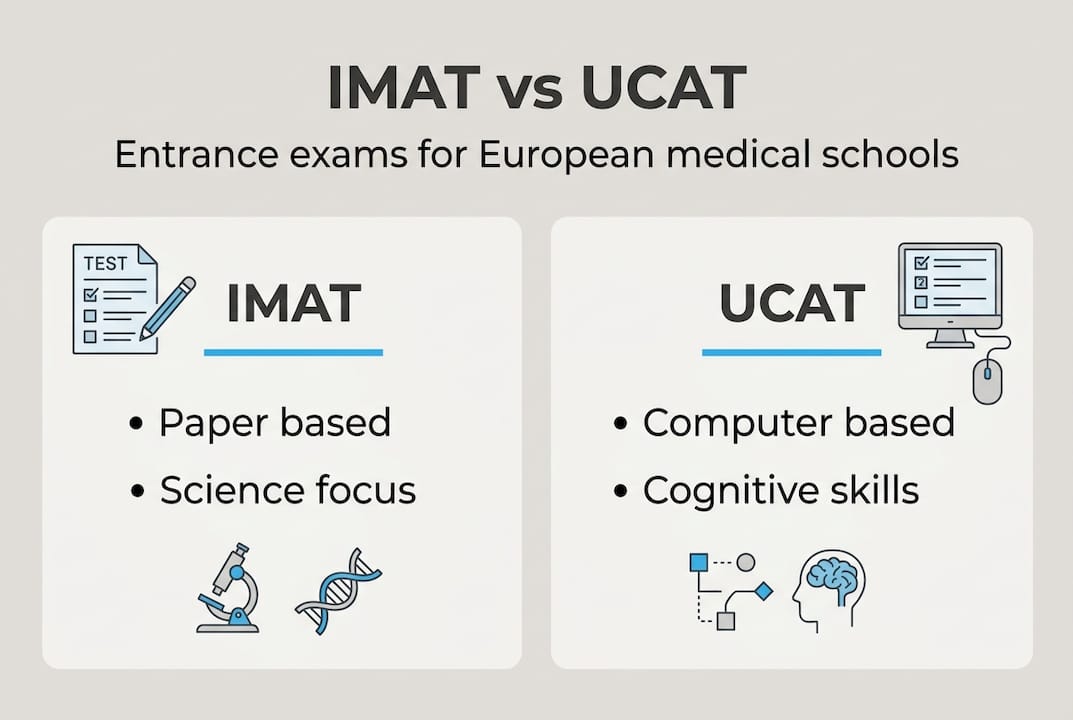
- IMAT is paper-based with science focus; UCAT is computer-based with reasoning emphasis.
- Choose your test based on target universities, exam format, your strengths, and regional availability.
Choosing between the IMAT and UCAT is one of the most consequential decisions a prospective international medical student can make, yet many applicants approach it without a clear understanding of what each exam actually tests or which schools accept it. Students from India, the Middle East, Africa, and South Asia often encounter conflicting advice online, leading to wasted preparation time and missed application windows. This guide breaks down both exams side by side, covering structure, content, eligibility, and strategic decision-making, so you can move forward with a targeted plan rather than a guess.
Table of Contents
- Overview of IMAT and UCAT
- Key differences: Structure, content, and scoring
- Eligibility and test availability for international students
- Which exam should you choose? Making the decision
- A real-world approach: What most students overlook when comparing IMAT and UCAT
- Get expert help for IMAT and UCAT success
- Frequently asked questions
Key Takeaways
| Point | Details |
|---|---|
| Exam purpose clarity | IMAT and UCAT serve different sets of European universities, so matching your test to your target is crucial. |
| Content and structure matter | Each exam has a distinct format and subject emphasis, so choose based on your academic strengths. |
| Plan for eligibility and logistics | Eligibility, test dates, and location availability can affect your optimal strategy and timeline. |
| Strategic application | Selecting the right exam can open more admission pathways and improve your chances of success. |
Overview of IMAT and UCAT
Before comparing the two exams, it is essential to understand what each one is designed to do and who it serves.
The IMAT, or International Medical Admissions Test, is an entrance exam created specifically for admission to English-language medical and dental degree programs at Italian state universities. Administered by Cambridge Assessment Admissions Testing, it evaluates candidates across science subjects, logical reasoning, and general knowledge. As stated by Cambridge Assessment Admissions Testing, IMAT is for Italian medical school admissions, while UCAT focuses on the UK and select other universities. If your goal is to study medicine in Italy at institutions like Pavia, Messina, or Catania, the IMAT is the required pathway.
The UCAT, or University Clinical Aptitude Test, serves a different purpose entirely. According to the UCAT Consortium, UCAT is widely used by UK medical and dental schools as part of their undergraduate admissions process. It is a computer-based cognitive test that measures mental abilities and behavioral attributes rather than subject knowledge. Most UK medical schools include UCAT scores as a key component of their selection process.
Here is a quick overview of what differentiates them at the most basic level:
- IMAT: Required for English-taught medical programs at Italian state universities; science and reasoning focused; administered once per year in September
- UCAT: Required by the majority of UK medical and dental schools; cognitive skills focused; no subject knowledge required
- IMAT acceptance: Italian state universities with English-language medicine programs
- UCAT acceptance: Over 30 UK and Australian medical and dental schools
- Who takes IMAT: International and EU students applying to Italian medicine programs
- Who takes UCAT: Students applying to UK and select international medical schools
Pro Tip: Before you begin any preparation, visit the official admissions page of every university on your shortlist and confirm which exam they require. Some programs accept neither and use their own tests.
For a broader view of both pathways and to understand which aligns with your goals, Future Meds Academy provides structured guidance tailored for international applicants.
Key differences: Structure, content, and scoring
Now that you know what each exam is for, it is important to look at how their structure and content can shape your preparation and performance.
The structural differences between the IMAT and UCAT are significant. IMAT is paper-based with various science and logical reasoning sections, while UCAT is computer-based with a focus on cognitive skills. These differences affect not just preparation style but also how you perform under exam conditions.

Here is a direct comparison:
| Feature | IMAT | UCAT |
|---|---|---|
| Format | Paper-based | Computer-based |
| Duration | 100 minutes | 2 hours (approx.) |
| Sections | Biology, Chemistry, Physics, Math, Logical Reasoning | Verbal Reasoning, Decision Making, Quantitative Reasoning, Abstract Reasoning, Situational Judgment |
| Scoring | Positive/negative marking | Scaled score per section |
| Science knowledge required | Yes | No |
| Frequency | Once per year | Multiple dates (July to September) |
For the IMAT, here is how the sections break down in terms of weighting:
- Logical reasoning and general knowledge: 10 questions
- Biology: 23 questions
- Chemistry: 15 questions
- Physics and mathematics: 12 questions
For the UCAT, each of the five sections has a distinct cognitive focus. Situational Judgment, for example, tests your ethical reasoning in healthcare scenarios, a component completely absent from the IMAT.
Scoring also differs considerably. The IMAT uses a positive/negative marking system where correct answers earn points and incorrect ones deduct them, making strategic guessing risky. The UCAT generates a scaled score per section, and universities set their own score thresholds.
Pro Tip: If you excel in structured science subjects and have strong content knowledge from your school curriculum, the IMAT may align naturally with your preparation style. If you prefer problem-solving under time pressure without subject revision, consider the UCAT structure carefully.
You can access practice tests for IMAT and UCAT through Future Meds Academy to evaluate which format suits you before committing fully.
Eligibility and test availability for international students
Understanding the content and structure is just part of the decision. Next, let's see who is eligible to take these exams, and how accessible each test is to international students.
For the IMAT, eligibility is relatively open. Any student who holds or expects to hold a secondary school qualification equivalent to the Italian diploma di maturita can apply. There are no nationality restrictions, which makes it particularly accessible for students from India, Nigeria, Egypt, Pakistan, and across the Gulf region. IMAT is usually taken in September with international centers available in select cities globally, though the primary administration occurs in Italy.
For the UCAT, international students can sit the exam outside the UK. UCAT is delivered in multiple international locations annually between July and September. Centers exist across Asia, Africa, and the Middle East, making it logistically viable for students in major cities.
Important: Registration for both exams opens several months before the test date. Missing the registration window is one of the most preventable reasons international applicants lose a full admissions cycle.
Common eligibility and scheduling mistakes to avoid:
- Registering without confirming your secondary school qualification is recognized
- Assuming test centers exist in your city without verifying on the official portal
- Confusing IMAT registration deadlines (which tie to the Italian Ministry of Education's timeline) with university application deadlines
- Overlooking UCAT's strict ID verification requirements for international candidates
- Not accounting for travel time and visa requirements if the nearest center is in another country
For students from South Asia and Africa specifically, the UCAT has been expanding its international center network, though availability still varies by country. Always verify UCAT test centers directly before planning your test date. For consolidated exam dates and center info, Future Meds Academy maintains updated resources for international applicants.
Which exam should you choose? Making the decision
With all the facts in hand, here is how you can make a confident, well-informed decision for your medical school goals.
Selecting the right test depends on target universities and your test-taking strengths, and this decision should never be based solely on which exam seems easier. Follow this step-by-step process:
- List your target universities. Identify the specific medical schools you want to apply to. Italian state universities require the IMAT; UK medical schools require the UCAT.
- Check exam requirements for each school. Some European universities outside Italy have their own entrance exams entirely. Do not assume IMAT or UCAT is universally accepted.
- Assess your academic strengths. If your school curriculum covered biology, chemistry, and physics in depth, the IMAT rewards that investment. If you are stronger in reasoning and analytical thinking, the UCAT format may suit you.
- Review test center availability in your region. If the nearest IMAT center requires international travel and visa logistics, factor that into your timeline.
- Evaluate career pathways. A UK medical degree and an Italian medical degree have different recognition pathways globally. Research license recognition in the country where you plan to practice.
Pro Tip: If you are applying to both Italy and UK programs simultaneously, treat each exam as a separate preparation project with its own timeline. Content overlap is minimal, so do not expect crossover preparation to be sufficient for both.
For a structured approach to exam preparation for IMAT vs UCAT, working with an experienced platform can help you allocate study time efficiently across both pathways.
A real-world approach: What most students overlook when comparing IMAT and UCAT
Most comparison articles stop at format and content. But there are strategic factors that materially affect your admissions outcome, and they rarely get mentioned.
The first is the admissions cycle itself. The IMAT is administered once annually, with no retake opportunity within the same cycle. If you underperform, you wait a full year. The UCAT offers more flexibility in scheduling, which gives candidates a psychological and strategic buffer that is genuinely valuable under pressure.
The second is the language of instruction. Both exams are conducted in English, but studying medicine in Italy means attending lectures, completing clinical rotations, and potentially interacting with patients in Italian over time. This is a long-term commitment that goes beyond passing one exam.
The third is a myth worth addressing directly: the belief that the IMAT is easier because it is "just science." IMAT competition is intense, with applicants from across the world competing for limited seats at top Italian universities. Following popular opinion rather than a personal assessment of your strengths leads to poor outcomes.
Align your exam choice with your learning style, your target country, and your long-term medical career goals. Find more strategy tips to build a pathway that is realistic and well-planned.
Get expert help for IMAT and UCAT success
If you want reliable guidance and practice that matches your exam choice, expert resources can make a real difference.

Future Meds Academy offers structured exam preparation for IMAT vs UCAT designed specifically for international students from India, the Middle East, Africa, and South Asia. From mock tests and interactive lessons to personalized mentorship and university application support, the platform covers every stage of your journey. Whether you are targeting universities in Italy or building a backup strategy for UK programs, the right preparation structure significantly improves your performance outcomes. Explore prep solutions that are built around the specific demands of international medical admissions.
Frequently asked questions
Can I apply to both IMAT and UCAT medical schools in the same year?
Yes, you can apply to both as long as you meet each university's requirements and registration deadlines. IMAT and UCAT application overlap is permitted for eligible candidates.
Which exam is harder, IMAT or UCAT?
The difficulty depends on your academic background. IMAT and UCAT test fundamentally different skill sets, with IMAT focusing on science content and UCAT prioritizing cognitive reasoning.
When are the IMAT and UCAT exams held?
IMAT is typically administered in September each year, while UCAT testing runs from July through September. Confirm the IMAT test date annually, as exact dates are set by the Italian Ministry of Education.
Are IMAT or UCAT scores accepted by universities outside Europe?
Generally no. Both exams are primarily recognized within their respective regions, with IMAT and UCAT accepted mainly by European and UK medical schools respectively.