
TL;DR:
- Pre-medical foundation programs prepare students lacking science prerequisites for European medical schools.
- They serve non-science graduates, international students, or those retaking entry exams with guaranteed progression paths.
- Choosing accredited, English-taught programs near target universities enhances admission success and medical career prospects.
Many aspiring medical students assume that gaining entry to a European medical school requires either exceptional high school grades in science or years of undergraduate study. That assumption leaves out a significant and strategically valuable option: the pre-medical foundation, a preparatory program designed for students who lack required science prerequisites or need to bridge educational gaps before formal medical training. Whether you graduated in a non-science field, fell short on grades, or completed a shorter secondary education, this pathway exists specifically for you. This guide covers what pre-medical foundation programs are, who they serve, how they function across Europe, and how to select the right one for your goals.
Table of Contents
- What is a pre-medical foundation program?
- Who needs a pre-medical foundation (and why)?
- How European pre-medical foundations work
- How to choose the right pre-medical foundation program
- Why pre-medical foundation programs are the real game-changer for IMAT and European medical entry
- Take the next step with a trusted pre-medical foundation partner
- Frequently asked questions
Key Takeaways
| Point | Details |
|---|---|
| Flexible entry route | Pre-medical foundations offer a bridge for students who lack the required science background or grades. |
| Tailored for IMAT/Europe | These short programs are designed for IMAT applicants and are more focused than US pre-med tracks. |
| Guaranteed progression | Many programs provide direct or preferred entry to partner medical schools after successful completion. |
| Choose wisely | The best results come from accredited, English-taught, and university-aligned foundations. |
What is a pre-medical foundation program?
A pre-medical foundation is a structured academic program that prepares students for entry into medical school when they do not yet meet the standard requirements. According to the University of St Andrews, a pre-medical foundation program is typically 3 to 12 months long and is specifically designed for aspiring medical students who lack required science prerequisites. These programs are not remedial. They are purpose-built academic pathways that bring students to the level expected by medical school admissions committees.
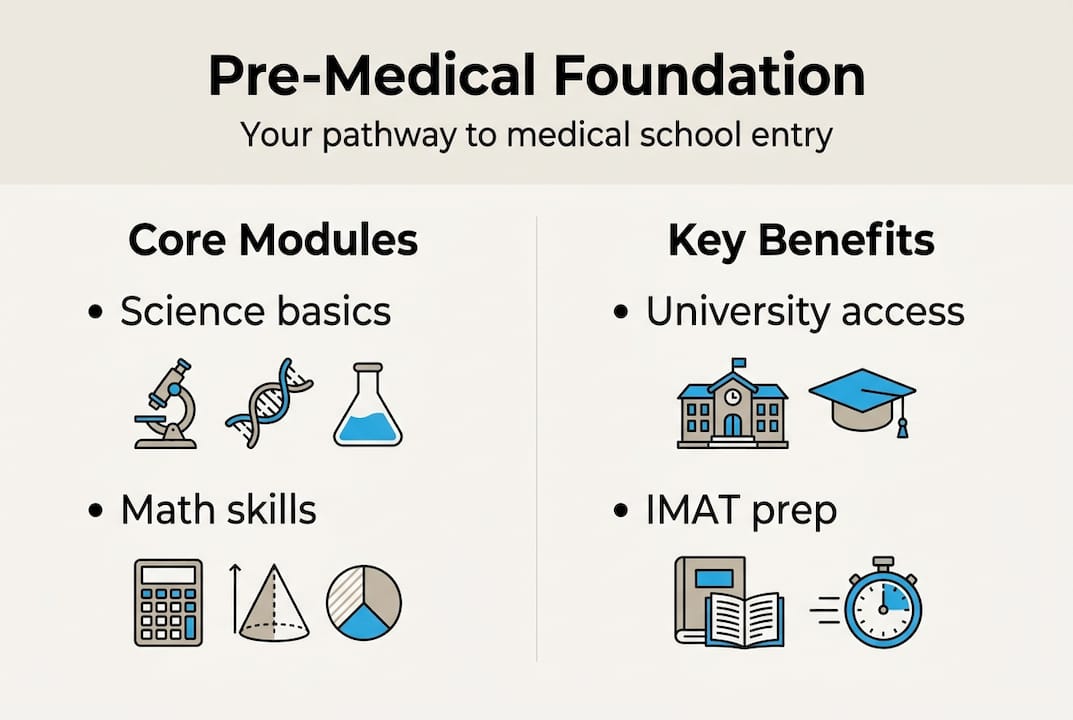
The curriculum typically covers the core science and academic subjects that underpin first-year medical study:
- Biology: cell biology, genetics, human physiology
- Chemistry: organic and inorganic chemistry, biochemistry fundamentals
- Physics: mechanics, electricity, optics relevant to medical imaging
- Mathematics: statistics, calculus basics, data interpretation
- Academic English: scientific writing, reading comprehension, research skills
Programs are usually structured in modules, with each module focusing on one subject area before progressing to the next. Many include laboratory sessions that simulate real scientific work, giving students hands-on exposure before they enter a full medical curriculum. Academic skills training, including how to write research summaries and interpret scientific data, is also a standard component.
The table below shows a typical structure for a 9-month European pre-medical foundation:
| Module | Duration | Key subjects |
|---|---|---|
| Science core | 3 months | Biology, Chemistry, Physics |
| Mathematics and data | 2 months | Statistics, calculus, data analysis |
| Academic English | 2 months | Scientific writing, reading, vocabulary |
| Lab and clinical skills | 1 month | Practical lab work, clinical observation |
| Exam preparation | 1 month | Mock tests, revision, IMAT readiness |
Pro Tip: Choosing English-taught, accredited programs that are geographically close to your target universities can meaningfully increase your acceptance odds. Explore recognized foundation pathways that align with European medical school entry standards before committing to any program.
Who needs a pre-medical foundation (and why)?
Understanding the structure and subjects is useful, but knowing whether you qualify or need a foundation year is crucial. Pre-medical foundation programs are not designed for one narrow type of student. They serve a broad range of applicants who arrive at medical school preparation from different starting points.
The following groups benefit most from these programs:
- Non-science graduates: Students who completed undergraduate degrees in humanities, social sciences, business, or other non-science fields often lack the biology and chemistry background required for medical school entry.
- Students who previously attempted medical entry and did not succeed: A foundation year provides structured re-preparation, often with more depth than self-study.
- Students from shorter secondary education systems: Some national curricula only require 11 or 12 years of schooling, which may not satisfy European medical school prerequisites.
- International applicants targeting IMAT-based admissions: Students from countries where science education differs significantly from European standards benefit from a program that aligns specifically with European expectations.
- Students with weaker science grades: Even those with science backgrounds may need to strengthen specific areas before attempting competitive admissions.
For students from non-science backgrounds, failed prior medical entry attempts, or 11 to 12 year high school systems, extended foundation options of 18 to 24 months exist to accommodate weaker science preparation. These extended programs allow more time for foundational concepts to be absorbed properly, reducing the risk of gaps that could affect performance in the first year of medical school.
Programs designed for various educational backgrounds can be found across the UK and Europe, with institutions like the University of St Andrews offering structured International Foundation Pathways specifically in medical sciences.
"Successful completion of an accredited pre-medical foundation often provides guaranteed or high-probability progression to partner medical schools, removing the uncertainty that comes with competitive open admissions."
This guaranteed progression model is one of the most compelling features of structured foundation programs. It shifts the focus from competitive ranking to personal performance, which is a fundamentally different and often more manageable challenge.
How European pre-medical foundations work
If you fall into one of those groups, here is what attending a European pre-medical foundation looks like in detail. These programs are more than a collection of science lessons. They are integrated academic experiences designed to simulate the rigor of medical school while still providing scaffolded support.
Core features of European pre-medical foundation programs include:
- Laboratory sessions: Hands-on work with microscopes, chemical reagents, and biological specimens
- Modular course structure: Sequential subject blocks that build on each other systematically
- Clinical exposure: Some programs include hospital observation or clinical skills workshops
- Academic English training: Formal scientific communication, which is essential for IMAT and European med school success
- Progression agreements: Formal pathways to partner medical schools upon successful completion
Costs vary significantly. Programs at institutions like UHSA Antigua start at approximately €2,200, while programs at universities such as the University of St Andrews can reach €12,000 or more. The average European pre-medical foundation runs approximately 9 months and costs between €4,000 and €8,000 depending on location and institution prestige.
The modular curriculum with labs and academic skills components means that progression is often guaranteed or carries a high success rate to partner schools, provided students meet the required performance benchmarks.

The table below compares European and US pre-medical pathways:
| Feature | European pre-med foundation | US pre-med track |
|---|---|---|
| Duration | 3 to 12 months | 3 to 4 years (undergraduate) |
| Structure | Standalone preparatory program | Embedded in bachelor's degree |
| Cost | €2,200 to €12,000 | $40,000 to $200,000+ |
| Entry requirement | High school completion | High school completion |
| Progression | Often guaranteed to partner schools | Competitive MCAT-based |
In contrast, the US pre-med track is a multi-year undergraduate program, not a brief foundation year. This distinction matters enormously for students who want to enter medical school faster and at lower cost.
Pro Tip: Before enrolling, verify that your chosen program offers visa support and has documented progression rates to specific medical schools. Use your pre-med checklist to compare programs systematically.
How to choose the right pre-medical foundation program
After understanding the structure and value, the next challenge is picking the right foundation based on your goals. Not all programs are equal, and selecting a poorly recognized or low-quality program can result in wasted time, money, and a weaker application.
When evaluating programs, prioritize the following criteria:
- Accreditation: Confirm the program is recognized by national or international education authorities and that its qualifications are accepted by your target medical schools
- Language of instruction: English-taught programs are essential for students targeting IMAT or other English-language medical admissions processes
- Proximity to target universities: Programs affiliated with or located near your target medical schools often have formal progression agreements
- Documented progression rates: Ask for data on what percentage of students successfully progress to medical school after completing the program
- Cost and financial support: Understand the full cost, including accommodation, and whether scholarships or payment plans are available
- Visa guidance: International students need programs that provide clear support for student visa applications
- IMAT alignment: If you are targeting Italian medical schools, check whether the program includes specific IMAT preparation components
It is critical to choose English-taught, accredited programs near target universities and to verify progression rates, costs, and visa support before committing. Programs that do not have formal university partnerships or accreditation may not be recognized by admissions committees, which can invalidate your preparation entirely.
The risks of choosing an unrecognized program are significant. Some programs market themselves as pre-medical preparation without having any formal agreements with medical schools. Students who complete these programs may find that their qualification is not accepted, forcing them to repeat preparation with a legitimate provider.
For IMAT applicants specifically, the key decision points include whether the program covers IMAT-relevant biology and chemistry content and whether it provides mock exam practice aligned with the test format.
Why pre-medical foundation programs are the real game-changer for IMAT and European medical entry
With a clearer understanding of how to select the right program, it is worth addressing why pre-medical foundations matter more than many students realize. The most common pattern we observe is that students only discover foundation programs after a failed admissions attempt. That reactive approach costs time and momentum.
Students who proactively choose a foundation year before attempting medical school entry arrive better prepared, more confident, and with a stronger academic profile. The foundation year does more than fill science gaps. It develops the academic habits, study discipline, and scientific reasoning skills that determine whether a student survives the first two years of medical school. Research consistently shows that students who struggle in early medical school years often lack foundational academic skills, not intelligence.
For IMAT applicants, a well-chosen foundation year can directly improve exam performance by reinforcing the biology and chemistry content that makes up the majority of the test. Expert guidance on medical school prep consistently points to structured pre-medical preparation as one of the highest-return investments an aspiring doctor can make.
Do not simply pick the cheapest or fastest path. Consider the support structures, the quality of academic skills training, and how well the program matches your ultimate goal of practicing medicine in Europe.
Take the next step with a trusted pre-medical foundation partner
Selecting the right pre-medical foundation is one of the most consequential decisions in your path to European medical school. Future MedsAcademy supports aspiring medical students through every stage of this process, from identifying the right foundation program to preparing for the IMAT and managing university applications.
Future MedsAcademy programs include tailored academic preparation, visa and application guidance, and structured IMAT coaching, all designed to give international students the strongest possible foundation for medical school entry. Whether you are starting from a non-science background or strengthening an existing science base, expert support is available to help you move forward with confidence.
Frequently asked questions
How long does a European pre-medical foundation usually take?
Most programs last 3 to 12 months, with extended options up to 24 months for students who need additional time to build science competency.
Is pre-medical foundation required for IMAT or European med schools?
It is essential for students lacking science prerequisites or coming from non-standard educational backgrounds, but not mandatory for students who already meet entry requirements.
Are there guaranteed progression opportunities after pre-medical foundation?
Many programs offer guaranteed progression to partner medical schools for students who meet performance benchmarks upon completion.
How do European pre-med programs differ from US pre-med tracks?
European programs are short and focused, typically one year or less, while the US pre-med pathway spans 3 to 4 years as part of an undergraduate degree with competitive MCAT-based entry.